Quantum panic meets Bitcoin reality.
By Maxime Laurent · 2026-04-10 14:51
Quantum panic meets Bitcoin reality.
QSB proposes a no-fork fix for quantum risk, but it’s expensive and feels more like an emergency button than a real upgrade.
I was reading this with a coffee by the sea this morning, and honestly… it’s one of those ideas that sounds wild at first, but actually reveals something deeper about $BTC. 🌊
So here’s the situation. Bitcoin today relies on ECDSA signatures, and yes — in theory, a powerful enough quantum computer running Shor’s algorithm could break that. Not today, not tomorrow, but the idea sits there in the background like a storm you know will come one day.
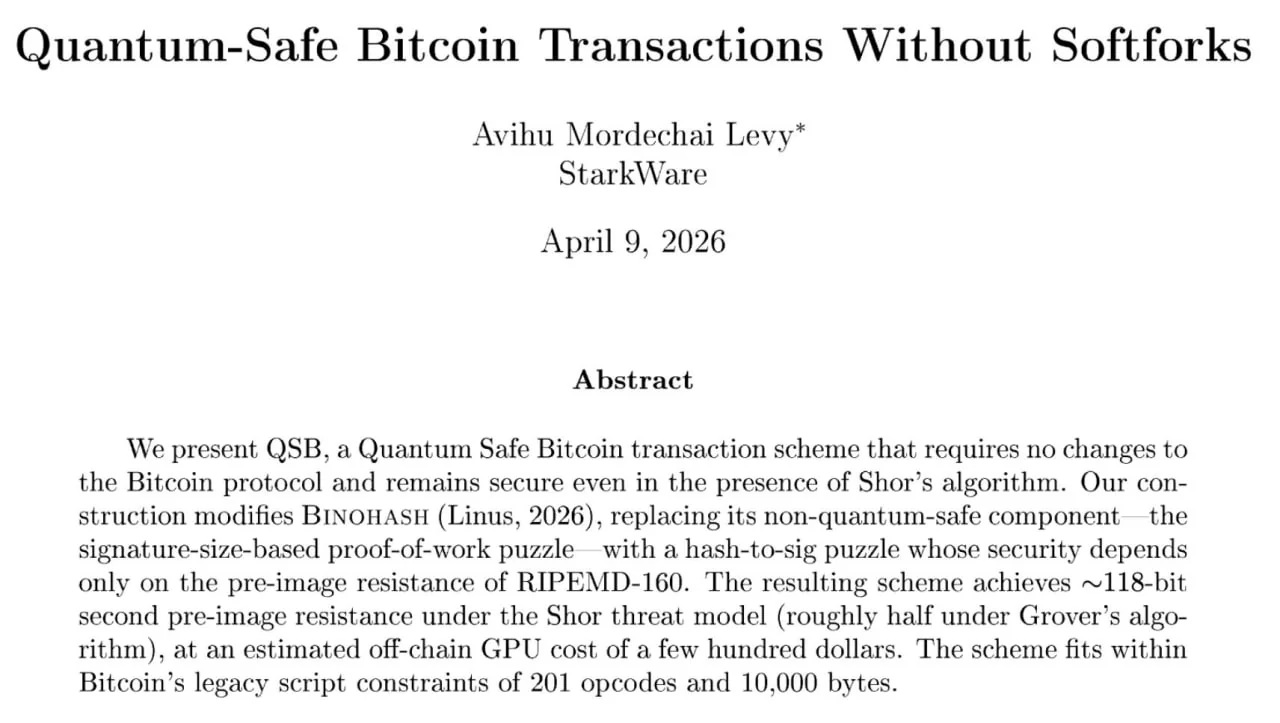
Now comes Avihu Levy with this concept: Quantum Safe Bitcoin (QSB). And the interesting part?
👉 No soft fork. No protocol change. Just using the existing Bitcoin Script in a clever way.
Instead of classical signatures, QSB introduces something called Binohash, a one-time signature approach tied to hashing and Proof-of-Work. Then it goes even further with this “hash-to-signature” idea — basically forcing the sender to solve a hashing puzzle to authorize a transaction.
And this is where it gets spicy.
Because unlike elliptic curve math, hash-based systems are much more resistant to quantum attacks. You can’t just throw Shor’s algorithm at it and call it a day. So in theory, even a very strong quantum computer hits a wall here.
But… there’s always a but.
💸 $75–150 per transaction.
Yeah. That’s not a typo.
At current cloud compute prices, securing a single transaction with QSB would cost more than most people’s entire monthly on-chain activity. Compared to a ~$0.3 average fee, this is not just expensive — it’s completely out of reach for normal usage.
So what is this really?
Not a replacement. Not even close.
It’s more like a glass box labeled “break in case of quantum emergency.”
A last-resort mechanism if things go south faster than expected. Et franchement, that’s actually kind of reassuring.
Because it shows something important about Bitcoin:
👉 even without changing the protocol, there’s still room for defensive creativity.
Will we need it? Maybe in 10–20 years. Maybe never.
Will Bitcoin eventually need a real quantum-resistant upgrade? Probably.
But for now, this feels like a reminder that $BTC is not as rigid as people think — it’s more like a system with hidden layers, waiting to be activated when the pressure rises.
And in crypto, pressure always comes. 🔥
#Bitcoin #BTC #QuantumComputing #CryptoSecurity #StarkWare #Innovation #Blockchain #CryptoThoughts
QSB proposes a no-fork fix for quantum risk, but it’s expensive and feels more like an emergency button than a real upgrade.
I was reading this with a coffee by the sea this morning, and honestly… it’s one of those ideas that sounds wild at first, but actually reveals something deeper about $BTC. 🌊
So here’s the situation. Bitcoin today relies on ECDSA signatures, and yes — in theory, a powerful enough quantum computer running Shor’s algorithm could break that. Not today, not tomorrow, but the idea sits there in the background like a storm you know will come one day.
Now comes Avihu Levy with this concept: Quantum Safe Bitcoin (QSB). And the interesting part?
👉 No soft fork. No protocol change. Just using the existing Bitcoin Script in a clever way.
Instead of classical signatures, QSB introduces something called Binohash, a one-time signature approach tied to hashing and Proof-of-Work. Then it goes even further with this “hash-to-signature” idea — basically forcing the sender to solve a hashing puzzle to authorize a transaction.
And this is where it gets spicy.
Because unlike elliptic curve math, hash-based systems are much more resistant to quantum attacks. You can’t just throw Shor’s algorithm at it and call it a day. So in theory, even a very strong quantum computer hits a wall here.
But… there’s always a but.
💸 $75–150 per transaction.
Yeah. That’s not a typo.
At current cloud compute prices, securing a single transaction with QSB would cost more than most people’s entire monthly on-chain activity. Compared to a ~$0.3 average fee, this is not just expensive — it’s completely out of reach for normal usage.
So what is this really?
Not a replacement. Not even close.
It’s more like a glass box labeled “break in case of quantum emergency.”
A last-resort mechanism if things go south faster than expected. Et franchement, that’s actually kind of reassuring.
Because it shows something important about Bitcoin:
👉 even without changing the protocol, there’s still room for defensive creativity.
Will we need it? Maybe in 10–20 years. Maybe never.
Will Bitcoin eventually need a real quantum-resistant upgrade? Probably.
But for now, this feels like a reminder that $BTC is not as rigid as people think — it’s more like a system with hidden layers, waiting to be activated when the pressure rises.
And in crypto, pressure always comes. 🔥
#Bitcoin #BTC #QuantumComputing #CryptoSecurity #StarkWare #Innovation #Blockchain #CryptoThoughts
Disclaimer: This content is for informational purposes only and not financial advice.