Oil chokepoint meets $BTC demand.
By Maxime Laurent · 2026-04-09 09:58
Oil chokepoint meets $BTC demand.
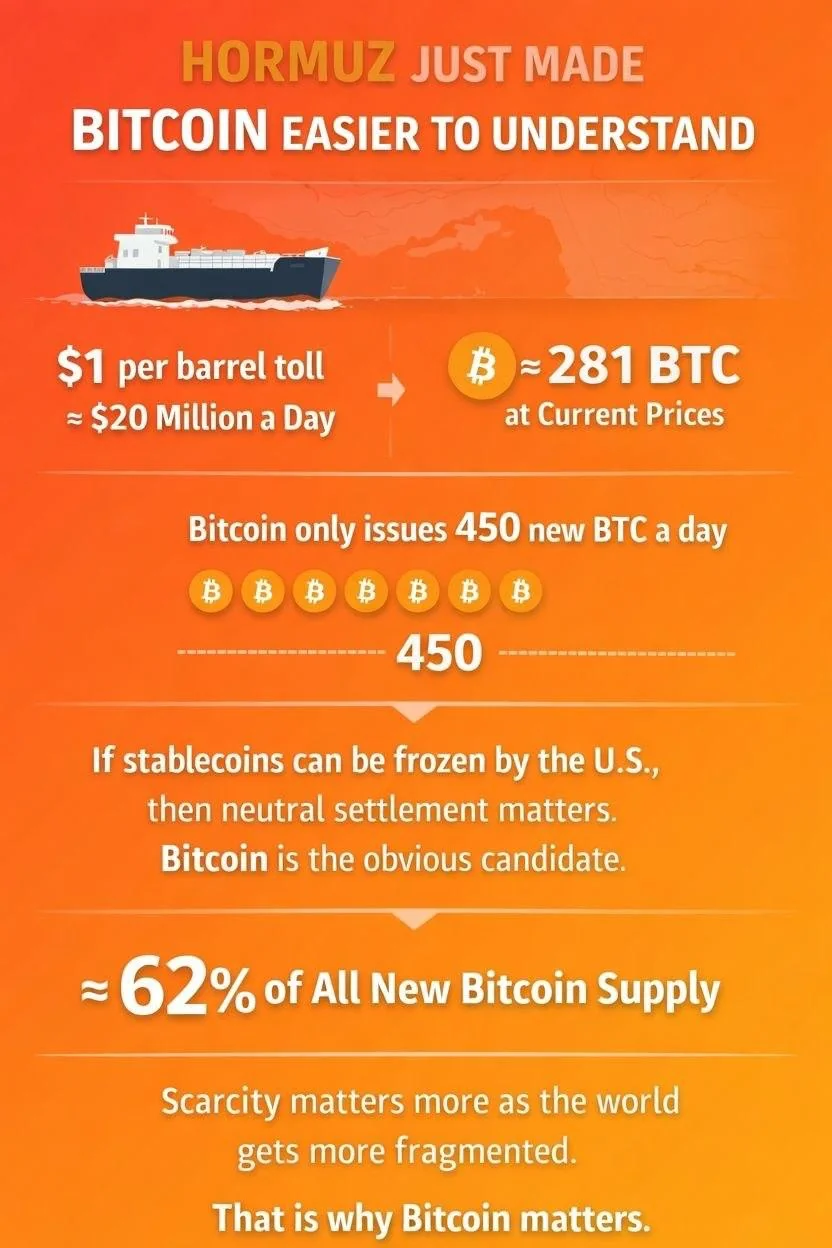
Up to 62% of daily $BTC issuance could be absorbed by Iran if oil trade in Hormuz shifts toward Bitcoin under sanctions.
There’s something almost cinematic about this scenario. The Strait of Hormuz — one of the most critical oil arteries on the planet — colliding with $BTC, the most neutral money we’ve ever seen.
If sanctions tighten and traditional settlement rails get blocked, countries like Iran don’t just stop trading. They adapt. And in that kind of pressure cooker, Bitcoin starts to look less like a speculative asset… and more like a tool.
Now, 62% of daily issuance sounds huge — and it is. Remember, new $BTC supply is already limited post-halving. If even a fraction of that scenario plays out, you’re talking about a structural buyer entering the market. Not a trader. Not a fund. A state-level necessity.
But let’s not get carried away too fast.
For this to actually happen, a lot of things need to align: enforcement of an oil embargo, willingness of counterparties to accept $BTC, infrastructure to settle large-scale trades, and the political risk tolerance on all sides. This isn’t plug-and-play.
Still… the direction is what matters.
Every time geopolitics tightens, every time traditional finance becomes harder to access, $BTC quietly steps into the conversation. Not loudly, not officially — but persistently.
And that’s how adoption often happens in this space. Not through hype… but through constraint.
Pas impossible. 🌊
#Bitcoin #BTC #Crypto #Macro #Oil #Iran #Geopolitics #Adoption
Up to 62% of daily $BTC issuance could be absorbed by Iran if oil trade in Hormuz shifts toward Bitcoin under sanctions.
There’s something almost cinematic about this scenario. The Strait of Hormuz — one of the most critical oil arteries on the planet — colliding with $BTC, the most neutral money we’ve ever seen.
If sanctions tighten and traditional settlement rails get blocked, countries like Iran don’t just stop trading. They adapt. And in that kind of pressure cooker, Bitcoin starts to look less like a speculative asset… and more like a tool.
Now, 62% of daily issuance sounds huge — and it is. Remember, new $BTC supply is already limited post-halving. If even a fraction of that scenario plays out, you’re talking about a structural buyer entering the market. Not a trader. Not a fund. A state-level necessity.
But let’s not get carried away too fast.
For this to actually happen, a lot of things need to align: enforcement of an oil embargo, willingness of counterparties to accept $BTC, infrastructure to settle large-scale trades, and the political risk tolerance on all sides. This isn’t plug-and-play.
Still… the direction is what matters.
Every time geopolitics tightens, every time traditional finance becomes harder to access, $BTC quietly steps into the conversation. Not loudly, not officially — but persistently.
And that’s how adoption often happens in this space. Not through hype… but through constraint.
Pas impossible. 🌊
#Bitcoin #BTC #Crypto #Macro #Oil #Iran #Geopolitics #Adoption
Disclaimer: This content is for informational purposes only and not financial advice.