Half of Ethereum is now locked.
By Maxime Laurent · 2026-02-18 15:21
Half of Ethereum is now locked.
Over 50% of $ETH supply sits in staking — and that changes the game.
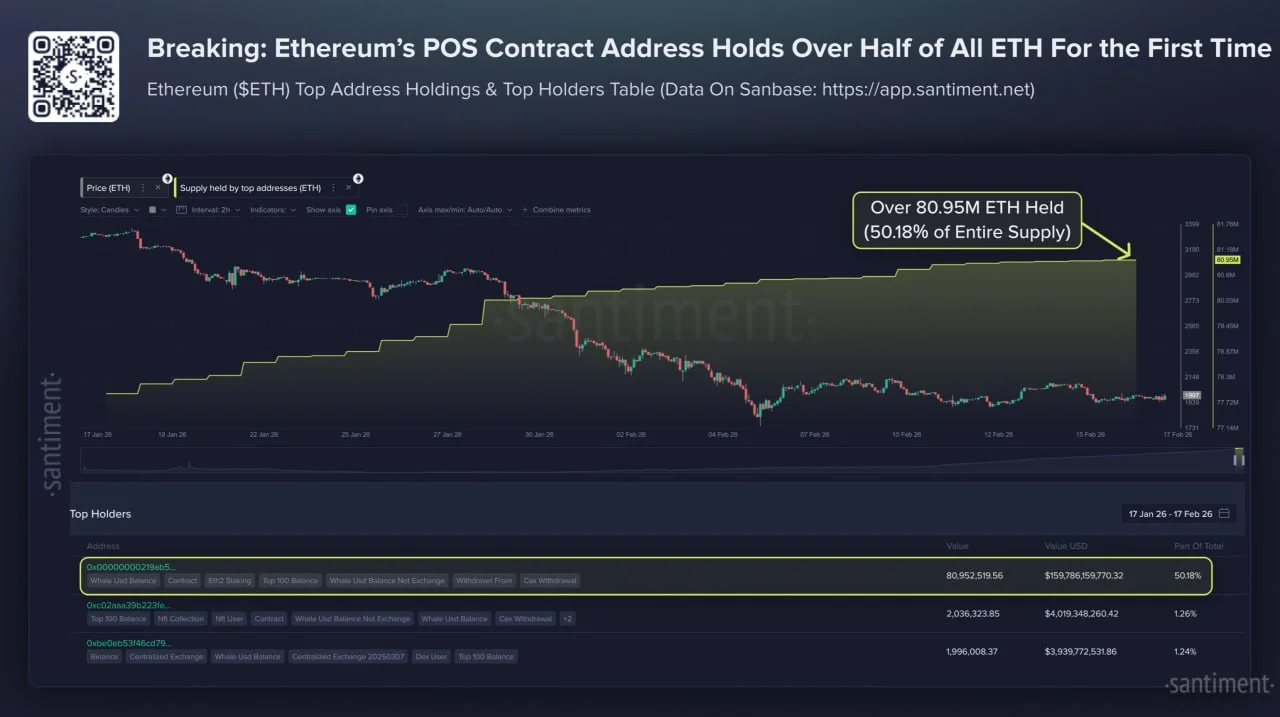
For the first time in its 11-year history, more than half of Ethereum’s total supply is locked inside the Proof-of-Stake contract.
According to on-chain data highlighted by Santiment, around 50.18% of all historically issued $ETH is now staked.
Let that sink in.
Half the supply isn’t trading.
It isn’t sitting on exchanges.
It’s committed.
This is not just a statistic. It’s a structural shift.
Since Ethereum moved to Proof-of-Stake, validators secure the network by locking their $ETH and earning yield. The more ETH staked, the stronger the economic security — but also the tighter the liquid float.
And here’s the timing: trading activity has been cooling down.
When volatility drops and narratives slow, many investors stop chasing short-term moves and switch to passive yield. Instead of trading, they stake. Instead of flipping, they hold.
That has consequences.
Less liquid supply means:
– Lower immediate sell pressure
– More sensitivity to demand spikes
– Stronger long-term alignment with the network
It also signals something psychological.
People aren’t just speculating on $ETH anymore.
They’re committing capital to its infrastructure.
Staking is a belief mechanism.
You don’t lock assets if you expect the system to collapse tomorrow.
From my terrace, watching the horizon blur into the sea, this feels like Ethereum entering a more mature phase. Less casino. More bond market energy.
Half the supply locked.
That’s not hype.
That’s conviction.
Et ça, c’est puissant. 🔥🌊
#Ethereum #ETH #Staking #ProofOfStake #Crypto #OnChain
Over 50% of $ETH supply sits in staking — and that changes the game.
For the first time in its 11-year history, more than half of Ethereum’s total supply is locked inside the Proof-of-Stake contract.
According to on-chain data highlighted by Santiment, around 50.18% of all historically issued $ETH is now staked.
Let that sink in.
Half the supply isn’t trading.
It isn’t sitting on exchanges.
It’s committed.
This is not just a statistic. It’s a structural shift.
Since Ethereum moved to Proof-of-Stake, validators secure the network by locking their $ETH and earning yield. The more ETH staked, the stronger the economic security — but also the tighter the liquid float.
And here’s the timing: trading activity has been cooling down.
When volatility drops and narratives slow, many investors stop chasing short-term moves and switch to passive yield. Instead of trading, they stake. Instead of flipping, they hold.
That has consequences.
Less liquid supply means:
– Lower immediate sell pressure
– More sensitivity to demand spikes
– Stronger long-term alignment with the network
It also signals something psychological.
People aren’t just speculating on $ETH anymore.
They’re committing capital to its infrastructure.
Staking is a belief mechanism.
You don’t lock assets if you expect the system to collapse tomorrow.
From my terrace, watching the horizon blur into the sea, this feels like Ethereum entering a more mature phase. Less casino. More bond market energy.
Half the supply locked.
That’s not hype.
That’s conviction.
Et ça, c’est puissant. 🔥🌊
#Ethereum #ETH #Staking #ProofOfStake #Crypto #OnChain
Disclaimer: This content is for informational purposes only and not financial advice.