Fake deposits, real panic avoided.
By Maxime Laurent · 2026-04-08 10:45
Fake deposits, real panic avoided.
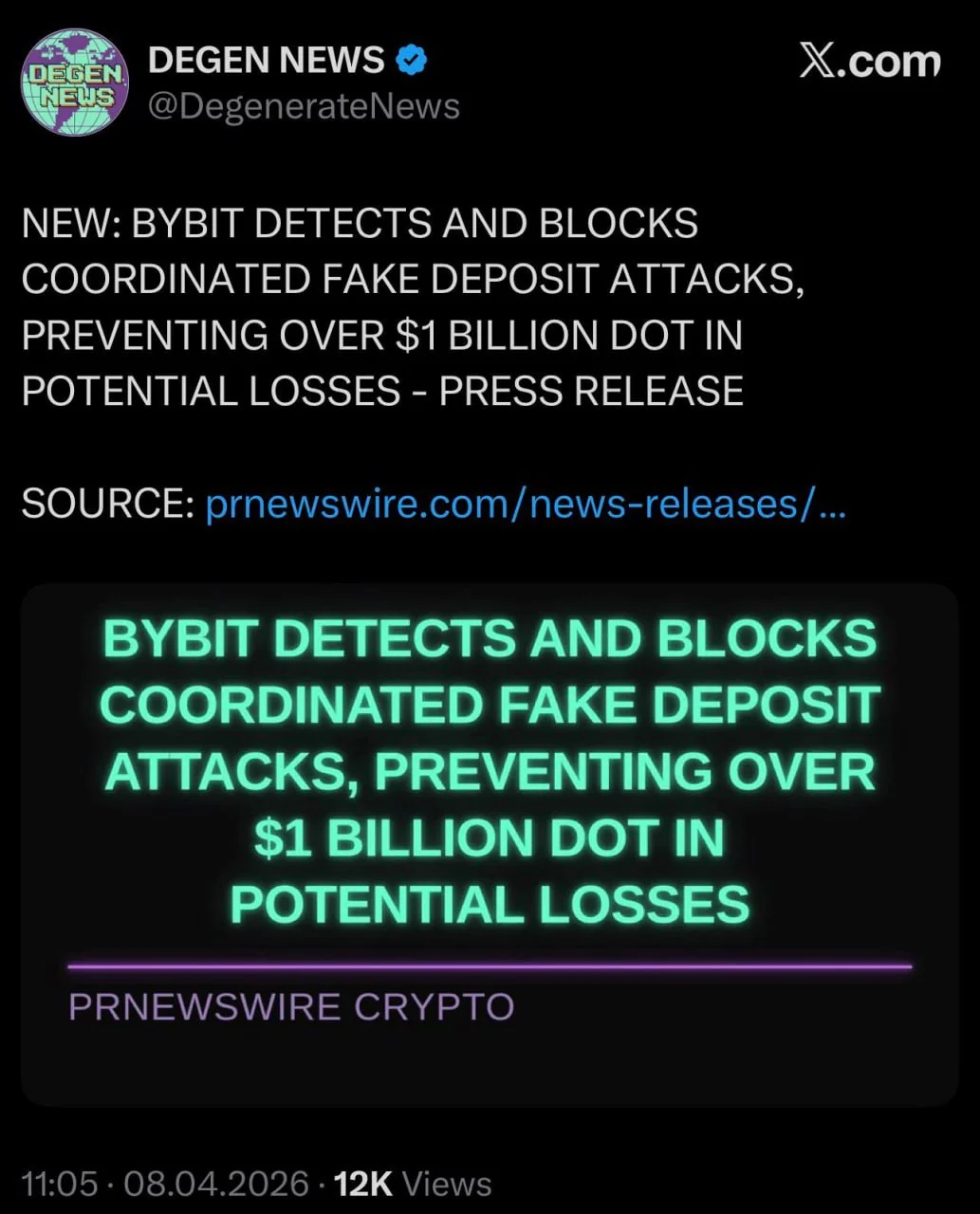
Bybit blocked a coordinated exploit that could have faked over $1B in $DOT deposits by tricking how systems read blockchain data.
There’s something almost poetic about this kind of attack — no brute force, no dramatic hack, just pure manipulation of perception. Hackers weren’t stealing funds directly… they were trying to convince the exchange that money existed when it didn’t. And honestly, that’s way more unsettling.
The trick was clever. Through complex batch transactions, they generated logs that looked like deposits. If a system only watches events — “oh look, tokens arrived” — without verifying the final balance state, it can get fooled. It’s like seeing a bank notification without checking your actual account balance.
And that’s where things could’ve gone very wrong. If even a fraction of those fake $DOT deposits had been credited, attackers could withdraw real assets against fake collateral. Boom — instant hole in the system. 💥
What I like here is not just that the attack failed, but how it failed. Detected in real time, across multiple networks, with zero fake funds credited. That tells you the backend checks weren’t just surface-level — they were looking at actual state, not just noise in the logs.
Still, it’s a reminder of something we tend to forget when the market is green and euphoric: infrastructure risk never sleeps. Exchanges are basically high-speed financial machines plugged directly into chaotic, adversarial networks.
Today it’s fake deposits. Tomorrow, something even more subtle.
C’est chaud. But that’s the game. Stay sharp. 🧠
#Crypto #Bybit #Security #DOT #Blockchain #DeFi #Hack #Trading
Bybit blocked a coordinated exploit that could have faked over $1B in $DOT deposits by tricking how systems read blockchain data.
There’s something almost poetic about this kind of attack — no brute force, no dramatic hack, just pure manipulation of perception. Hackers weren’t stealing funds directly… they were trying to convince the exchange that money existed when it didn’t. And honestly, that’s way more unsettling.
The trick was clever. Through complex batch transactions, they generated logs that looked like deposits. If a system only watches events — “oh look, tokens arrived” — without verifying the final balance state, it can get fooled. It’s like seeing a bank notification without checking your actual account balance.
And that’s where things could’ve gone very wrong. If even a fraction of those fake $DOT deposits had been credited, attackers could withdraw real assets against fake collateral. Boom — instant hole in the system. 💥
What I like here is not just that the attack failed, but how it failed. Detected in real time, across multiple networks, with zero fake funds credited. That tells you the backend checks weren’t just surface-level — they were looking at actual state, not just noise in the logs.
Still, it’s a reminder of something we tend to forget when the market is green and euphoric: infrastructure risk never sleeps. Exchanges are basically high-speed financial machines plugged directly into chaotic, adversarial networks.
Today it’s fake deposits. Tomorrow, something even more subtle.
C’est chaud. But that’s the game. Stay sharp. 🧠
#Crypto #Bybit #Security #DOT #Blockchain #DeFi #Hack #Trading
Disclaimer: This content is for informational purposes only and not financial advice.