Bhutan quietly exits its Bitcoin dream.
By Maxime Laurent · 2026-04-11 12:33
Bhutan quietly exits its Bitcoin dream.
A silent 71% drop in reserves hints at a deeper shift — from mining ambition to economic realism.
I remember when Bhutan entered the crypto conversation — it felt almost poetic. A small Himalayan kingdom, powered by clean hydro energy, turning waterfalls into $BTC. There was something pure about that narrative, almost like crypto returning to nature 🌊⚡️
At its peak, holding around 13,000 $BTC, Bhutan wasn’t just experimenting — it was committing. Quietly, without the noise of Western headlines, they were building one of the most fascinating sovereign crypto strategies out there.
But reality… always catches up.
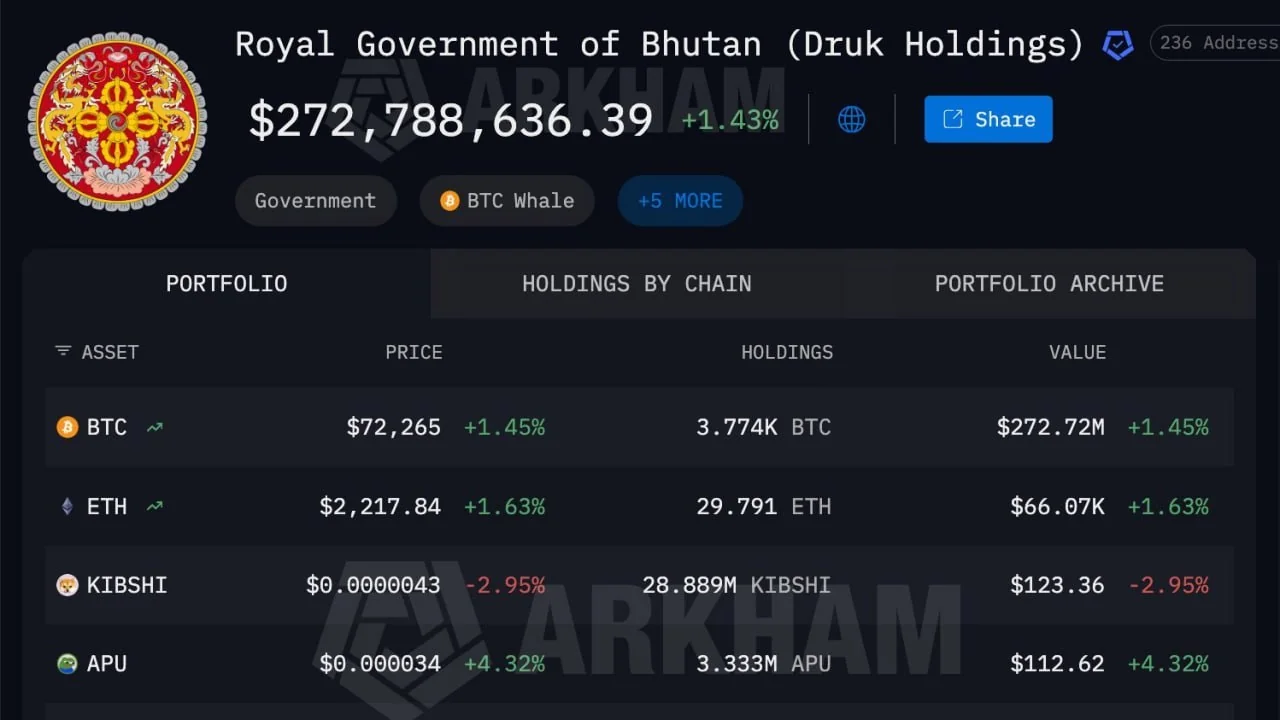
Now sitting at 3,774 $BTC, the drop isn’t just numbers on a chart — it feels like the end of a chapter. Mining, once profitable thanks to excess hydroelectric power, seems to have lost its edge. No inflows since late 2024, and that tells you everything. The game changed: higher difficulty, tighter margins, and probably a shift in national priorities.
And honestly? I get it.
Mining today isn’t the romantic, early-days hustle anymore. It’s industrial, competitive, brutal. Even with cheap energy, you’re playing against giants with scale, hardware, and insane optimization. At some point, you ask yourself: “Pourquoi continuer ?” 🤷♂️
But here’s the interesting part — Bhutan didn’t exit crypto. They adjusted. They’re still holding thousands of $BTC. That’s not abandonment, that’s strategy.
To me, this feels like a transition from “producer” to “holder.” From mining the asset… to believing in it.
And maybe that’s the real story here.
Not every country needs to mine. But the ones that understand what they’re holding? Those are the ones I’m watching closely.
#Bitcoin #Crypto #BTC #Mining #Macro #Adoption
A silent 71% drop in reserves hints at a deeper shift — from mining ambition to economic realism.
I remember when Bhutan entered the crypto conversation — it felt almost poetic. A small Himalayan kingdom, powered by clean hydro energy, turning waterfalls into $BTC. There was something pure about that narrative, almost like crypto returning to nature 🌊⚡️
At its peak, holding around 13,000 $BTC, Bhutan wasn’t just experimenting — it was committing. Quietly, without the noise of Western headlines, they were building one of the most fascinating sovereign crypto strategies out there.
But reality… always catches up.
Now sitting at 3,774 $BTC, the drop isn’t just numbers on a chart — it feels like the end of a chapter. Mining, once profitable thanks to excess hydroelectric power, seems to have lost its edge. No inflows since late 2024, and that tells you everything. The game changed: higher difficulty, tighter margins, and probably a shift in national priorities.
And honestly? I get it.
Mining today isn’t the romantic, early-days hustle anymore. It’s industrial, competitive, brutal. Even with cheap energy, you’re playing against giants with scale, hardware, and insane optimization. At some point, you ask yourself: “Pourquoi continuer ?” 🤷♂️
But here’s the interesting part — Bhutan didn’t exit crypto. They adjusted. They’re still holding thousands of $BTC. That’s not abandonment, that’s strategy.
To me, this feels like a transition from “producer” to “holder.” From mining the asset… to believing in it.
And maybe that’s the real story here.
Not every country needs to mine. But the ones that understand what they’re holding? Those are the ones I’m watching closely.
#Bitcoin #Crypto #BTC #Mining #Macro #Adoption
Disclaimer: This content is for informational purposes only and not financial advice.